The rechargeable remote disconnects entirely from the unit — no wall outlet, no cord to trip over — so a 110-lb caregiver can lift a 190-lb person off the floor at 1 a.m. without calling anyone for help.
The flagship floor lift chair carries 440 lbs on an industrial-grade steel frame with welded joints — heavy enough that buyers describe it as built to outlast the need for it, not just get through a return window.
The floor lift chair's mute motor runs without the loud mechanical grinding common in this category — a real consideration for users with dementia or cognitive sensitivity, where motor noise alone can turn a transfer into a crisis.
A floor lift chair handles post-fall recovery when the user still has leg strength; a sling-based patient lift handles full or partial paralysis; a travel scooter serves active seniors who need mobility, not fall recovery — MediHoist doesn't market one product as right for everyone.
MediHoist makes three distinct lift products — two steel floor lift chairs for post-fall recovery, one aluminum patient lift for full-body transfers, and a foldable travel scooter for seniors who need mobility on the go. The right one depends on how much mobility the user still has, so read the short descriptions below before deciding.
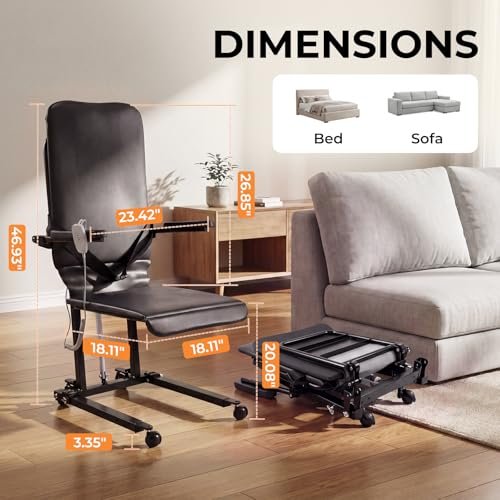
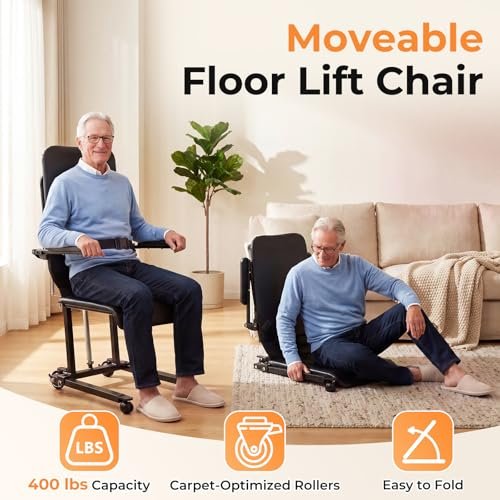
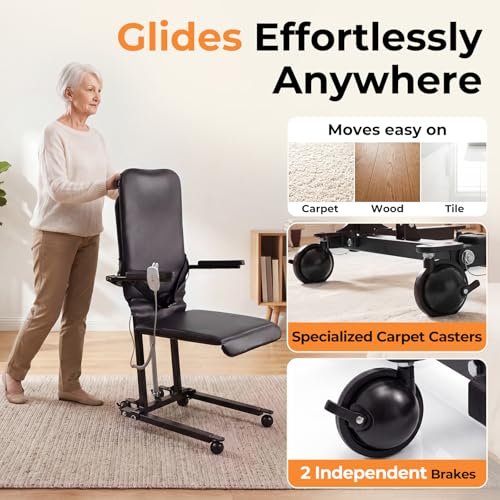
The S001 floor lift chair carries 400 lbs on an industrial-grade steel frame, rolls on upgraded casters across hardwood, tile, and low-pile carpet, and runs on a rechargeable remote that needs no wall outlet. At 42 lbs and 18×18×46 inches, it folds flat for storage and includes a PU leather cushion, safety seat belt, and handrails.
The rechargeable remote means a solo caregiver can operate this from anywhere in the room — no cord, no outlet, no second person required.
See on Amazon
The Steel-BR carries the highest weight capacity in MediHoist's floor lift line — 440 lbs — on the same industrial-grade steel frame, with a generously padded seat and backrest that verified buyers describe as superior to rigid plastic alternatives. At 41 lbs and 18×18×47 inches, it's 1 lb lighter and 1 inch taller than the S001, and comes in Brown for buyers who want the chair to blend into home furnishings rather than look clinical.
If weight capacity is the deciding factor — bariatric users or caregivers who need every pound of rated margin — this is the floor lift chair to buy.
See on Amazon
This is a fundamentally different product from the floor lift chairs — a full sling-based electric patient lift for users with complete or partial paralysis who cannot bear weight through their legs. The aluminum frame weighs 57 lbs (44% lighter than standard steel models), the 8,000N MOTECK motor is IPX6 waterproof, and the unit delivers up to 120 lifts per charge. The 360° rotating jib, adjustable base spanning 19.69–37 inches, emergency stop, and manual descent mechanism are the features caregivers doing daily transfers actually rely on.
If the person being transferred cannot push through the stand on their own at all, this patient lift — not a floor lift chair — is the right product.
See on Amazon
The YL-985S sits in a different category entirely — it's a travel mobility scooter, not a lift device. The aluminum frame weighs 37.5 lbs, folds in one second, covers 24 miles on dual 10AH batteries at up to 5 mph, and arrives fully assembled. Airline approved (subject to individual airline requirements), with electromagnetic brakes, anti-tip wheels, LED headlights, puncture-resistant tires, and a front storage bag included.
Built for active seniors who need mobility for travel, errands, or outdoor use — not for users who need fall recovery or bed-to-wheelchair transfers.
See on AmazonDiscover the full product lineup with current selection on Amazon.
All products on AmazonThe right product depends on one question: how much can your family member do on their own? A floor lift chair works when the user still has some leg strength — it assists the final push from ground to standing. A full patient lift handles everything when they can't bear weight at all. Getting this wrong is expensive and, more importantly, dangerous.
This is the situation most buyers are in. Someone fell, or they've been struggling to rise from chairs and floors for months, but when you hold them under the arms they can push through the last few inches. That retained leg strength is the key variable. The floor lift chair positions beneath them, raises them to standing height, and their legs complete the motion using the handrails for support.
Both the S001 Steel Floor Lift Chair (Black) and the Steel Floor Lift Chair 440 lb (Brown) serve this situation. The difference between them is weight capacity — 400 lbs on the S001 versus 440 lbs on the flagship — and color. If the user weighs over 380 lbs, go with the 440-lb model. If blending into a living room matters, the brown finish reads less clinical than standard black.
Who this is NOT for: anyone who cannot initiate standing motion at all. Placing a fully paralyzed person in a floor lift chair without sling support creates a fall risk mid-lift.
If the user needs to be moved between bed, wheelchair, toilet, or vehicle regularly — and especially if one caregiver is doing this alone multiple times a day — a stand assist device bridges the gap between floor lift chairs and full sling systems. This is the tier where professional home health aides and CNAs spend most of their time.
The practical test: can they push at all through their legs when supported? Even 20% of their body weight counts. If yes, stand assist. If they're dead weight in both legs, move to Tier Three.
The Aluminum Electric Patient Lift 300 lb is built for this situation. The sling supports the entire body — the user doesn't need to contribute anything. The 8,000N MOTECK motor handles up to 300 lbs of dead weight, the 360° rotating jib repositions without moving the base, and the emergency stop plus manual descent mechanism means a power interruption mid-transfer doesn't leave anyone suspended.
At 57 lbs with an aluminum frame, it's 44% lighter than steel alternatives in this category, which matters when a single home health aide is moving it between rooms or loading it for transport. The adjustable base spans 19.69 to 37 inches — narrow enough to fit through a 24-inch bathroom doorway, wide enough to straddle a standard toilet.
One more honest note: the patient lift requires a caregiver who's been shown how to position the sling correctly. First-time users should watch the setup video and ideally practice once before a real transfer. This isn't a criticism of the product — it's true of every sling-based system regardless of brand.
If you're genuinely unsure which tier applies, call the user's doctor or physical therapist before purchasing. One 10-minute phone call is worth more than any product description here.
Real-world performance in this category rarely matches the product illustrations. Here's what verified buyers have flagged — good and bad — so you're not discovering any of this at 1 a.m. with someone on the floor.
At 42 lbs, the S001 floor lift chair is heavier than some competitors. The MAIDeSITe alternative, reviewed extensively in caregiver forums, comes in around 30 lbs. That 12-lb difference is almost entirely accounted for by the welded steel joints and industrial-grade frame. One verified Amazon buyer described the construction as "heavy enough to last the rest of my life" — which is probably the right frame for evaluating the trade-off.
The casters are the practical answer to the weight question. You don't carry this chair between rooms — you roll it. On hardwood, tile, and low-pile carpet, the casters move smoothly. High-pile or shag carpet is a different story: expect more resistance, and on very thick carpet you may need to lift and reposition. No floor lift chair in this category rolls effortlessly on shag. That's a flooring problem more than a product problem, but it's worth knowing before your first transfer night.
This is the one point where a verified buyer flagged a real disconnect between the product illustrations and reality. When the steel floor lift chair folds, the rear casters stay on the ground and the front casters point upward. It rolls like a hand truck, not a flat piece of equipment that slides under a bed.
If under-bed storage is your plan, this won't work that way. Closet corner storage, against a wall in a hallway, or in a spare room — all fine. The folded footprint is genuinely compact, and the roll-out motion means one person can move it without lifting anything. Just don't expect it to lie flat.
The floor lift chair motor is described as a "mute motor" in the product specs, and in practice this holds up. The mechanical sound is low enough that users with dementia or cognitive sensitivity typically don't react to it. This is more significant than it sounds: caregiver forums on Reddit repeatedly note that motor noise alone can turn a smooth transfer into a frightening experience for someone with Alzheimer's. The MediHoist motor won't eliminate that risk entirely, but it reduces it meaningfully compared to louder alternatives in the category.
The remote charges from a wall outlet between uses and operates the lift motor without any cord connecting it to the chair during transfers. That means no tripping hazard during a nighttime emergency, and no fumbling with a plug when someone is already on the floor. The most cited real-world success story in MediHoist's Amazon reviews involves a 79-year-old woman — 110 lbs — getting her 190-lb husband with dementia off the bedroom floor alone at 1 a.m. The cordless remote is a significant part of why that was physically possible without waking someone else up.
Keep the remote charged between uses. That's the one maintenance habit that matters most for this product.
The Aluminum Electric Patient Lift 300 lb performs exactly as advertised, but the first transfer shouldn't be the first time you've positioned the sling. Run through the motion once — no patient, just the sling and the chair — so the mechanics are familiar before you're doing it for real. The 360° rotating jib and adjustable base make repositioning much less effortful than older Hoyer-style systems, but the sling wrap still requires attention. The emergency stop is a single button, and the manual descent runs mechanically independent of the battery. Know where both are before you start.
Most product pages describe lift chairs being used in a living room or bedroom. Those aren't the situations that catch caregivers off guard. It's the bathroom at 6 a.m., the bathtub that someone can't get out of, the narrow hallway between the bedroom and the toilet. Here's what actually applies in those settings.
The steel floor lift chairs can be used inside a standard bathtub. The PU leather cushion is waterproof — it wipes clean and doesn't absorb moisture, which is why it works in a wet environment. A caregiver reviewing the MAIDeSITe competitor on happyhealthycaregiver.com specifically flagged bathtub use as "something I wish I'd known earlier" and noted it would have changed her family's care approach significantly during a difficult period.
Practically, this means: if someone has slipped in the tub and can't get out, or if bathing transfers are a daily challenge, the floor lift chair isn't limited to bedroom and living room use. The casters will roll across a dry bathroom floor to the tub edge. Inside the tub, the frame sits flat on the tub floor. The motor operates normally.
One genuine limitation to state clearly: the chair needs to fit inside your tub before this is viable. The seat dimensions are 18×18 inches. Measure your tub's interior width before planning around bathtub use.
The floor lift chair's base width determines whether it can navigate through a doorway with the chair open. Standard interior doorways in US homes are 32 inches wide — the chair's footprint fits through those openings when approached straight on. Very narrow older home doorways (28 inches or less) may require the chair to be folded, rolled through, then repositioned.
For the Aluminum Electric Patient Lift 300 lb, the adjustable base spans 19.69 to 37 inches. At its narrowest setting, it fits through a 24-inch interior bathroom door — the minimum width found in most US homes. That's the practical threshold for bathroom transfer use. Set the base narrow to enter, widen it once positioned over the toilet or beside the tub for stability.
The 360° rotating jib matters here. In a small bathroom, there isn't room to reposition the entire lift between a toilet transfer and a wheelchair placement. The jib swings the patient to the new position without moving the base — which means fewer steps in tight quarters and less risk of catching a wheel on a threshold or bath mat edge.
The Aluminum Electric Patient Lift 300 lb is specifically rated for vehicle transfers, with one constraint: the destination seat height cannot exceed 27.6 inches. Most standard car seats fall in the 17–21 inch range, which is well within this limit. SUV and truck seats, which often sit higher, may push closer to or past that threshold — measure before attempting.
The aluminum frame at 57 lbs is light enough for one person to load into a vehicle cargo area or trunk between uses. The folded dimensions — 48.4×24×13.8 inches — fit in the back of most mid-size SUVs lying flat. For caregivers who manage transfers at multiple locations (home, a care facility, a medical appointment), portability is a real advantage over steel-frame alternatives that can exceed 80 lbs.
The cordless remote on the floor lift chairs makes overnight emergency use genuinely viable for a solo caregiver. There's no outlet to locate in a dark room, no cord to trace across the floor while someone is on the ground. Keep the remote on the nightstand or clipped to a caregiver's belt during transfers — it operates the full lift cycle from a single button press.
For the patient lift, the manual descent mechanism is the overnight safety feature that matters most. If the battery dies mid-transfer — unlikely given the 120-lift charge capacity, but possible if the unit hasn't been charged recently — the manual descent brings the patient down mechanically without power. Know where that mechanism is before you need it. It's not a feature you want to find for the first time in an emergency.
Medicare may cover part of an electric lift chair — but not the part you're probably thinking of, and not through Amazon. The distinction matters because buyers who don't understand it often end up paying full price for something they thought would be reimbursed.
Medicare Part B covers the motorized seat-lift mechanism as durable medical equipment (DME) — not the chair itself. In practice, this means Medicare may reimburse a portion of the mechanism's cost if the following conditions are all met:
The chair surrounding the mechanism does not qualify for Medicare reimbursement under any circumstance. If the covered mechanism portion costs $350 and Medicare's allowed amount is $300, Medicare pays 80% of the $300 — roughly $240 — and the patient pays the remaining 20% plus the full cost of the chair. This is materially different from "Medicare pays for the lift chair."
Medicare requires that covered DME be ordered through a Medicare-enrolled supplier. MediHoist's floor lift chairs sold on Amazon are not purchased through a Medicare-enrolled supplier — they're retail purchases. Buying a chair independently and submitting the receipt for reimbursement after the fact is not an option under Part B's DME coverage rules. The coverage path requires the pre-purchase involvement of both a prescribing physician and an enrolled supplier, in that order, before the equipment is delivered.
This isn't specific to MediHoist. It applies to virtually every lift chair sold on Amazon in this category.
If Medicare coverage is a priority, start with the prescribing physician — not the product. Get a documented medical necessity determination first. Then contact a Medicare-enrolled DME supplier (the Medicare website's supplier directory at medicare.gov lists enrolled suppliers by zip code) and ask specifically about lift chair mechanism coverage before ordering anything.
The supplier will know the current reimbursement rates, the documentation requirements, and whether your state has additional Medicaid coverage that might apply. This process takes time — typically 2–4 weeks before equipment is delivered — so it's not viable for immediate fall recovery situations.
Full patient lifts with slings are a separate Medicare category from lift chairs. Medicare Part B may cover patient lifts (including sling lifts) as DME when a physician documents medical necessity and the order goes through an enrolled supplier. The same pre-purchase, supplier-based process applies. Community discussions on Reddit's caregiver forums note that Hoyer-style sling lift systems — which run $3,000–$4,000 through clinical channels — are occasionally covered through this route, making the covered cost manageable. MediHoist's aluminum patient lift is available on Amazon for a fraction of that clinical price; check current pricing on Amazon to see the comparison for yourself.
If you're unsure whether your situation qualifies for any coverage, the State Health Insurance Assistance Program (SHIP) provides free Medicare counseling and can be reached through benefitsandcoverage.gov. They'll give you a straight answer about your specific case without trying to sell you anything.
We embedded this walkthrough from Total Therapy Solution because it shows the floor lift chair doing its job in an actual physical therapy clinic—not a staged demo room. You'll see a 440-lb rated chair roll into position, get set up without tools, and assist with fall recovery the way it's meant to work in a home setting. If you're trying to picture whether this can realistically work for your situation, this is the clearest look we've found.
The tables below cover each product line separately — because comparing a floor lift chair to a patient lift is like comparing a ramp to a crane. They solve different problems. Use these specs to confirm the right fit before you buy.
| Feature | S001 Steel Floor Lift Chair (Black) | Steel Floor Lift Chair 440 lb (Brown) |
|---|---|---|
| Weight Capacity | 400 lbs | 440 lbs |
| Frame Material | Industrial-grade steel | Industrial-grade steel |
| Unit Weight | 42 lbs | 41 lbs |
| Seat Dimensions | 18 × 18 inches | 18 × 18 inches |
| Chair Height | 46 inches | 47 inches |
| Cushion Type | PU leather | PU leather, generously padded seat and backrest |
| Remote | Rechargeable handheld, no outlet required | Rechargeable handheld, no outlet required |
| Motor | Quiet / mute motor | Quiet motor |
| Casters | Advanced upgraded casters | Upgraded smooth-rolling casters |
| Surface Compatibility | All surfaces including carpet | All surfaces including carpet |
| Foldable | Yes | Yes |
| Safety Features | Seat belt, handrails | Seat belt, handrails |
| Color Options | Black | Brown, Black |
| Amazon Rating | 4.3 stars (172 reviews) | 4.4 stars (48 reviews) |
The S001 and the Steel-BR are functionally very close — same frame philosophy, same remote, same surface range. The real decision comes down to two things: if you're in the 400–440-lb zone, go Steel-BR; if the chair will live in a home setting where brown blends better than black, same answer. The S001 has more verified buyer feedback if real-world data matters to you.
| Specification | Detail |
|---|---|
| Max Load Capacity | 300 lbs |
| Frame Material | Premium aluminum |
| Unit Weight | 57 lbs (44% lighter than standard models) |
| Operational Dimensions | 39.6 × 24.2 × 50 inches |
| Folded Dimensions | 48.4 × 24 × 13.8 inches |
| Leg Width Expansion | Up to 37 inches |
| Lifting Range | Up to 66.1 inches |
| Ground Clearance | 1.6 inches |
| Base Height | 4.7 inches |
| Motor | MOTECK 24V pushrod motor, 8,000N lifting force |
| Motor Speed (no load) | 8.2 mm/s |
| Waterproofing | IPX6 |
| Lifts Per Charge | Up to 120 |
| Front Casters | 3-inch swivel casters |
| Rear Casters | 4-inch casters with brakes |
| Jib Rotation | 360° |
| Safety Features | Emergency stop, manual descent mechanism |
| Included Accessories | Toileting sling |
| Transfer Destinations | Sofa, wheelchair, toilet, bed, vehicle (seat height ≤ 27.6 inches) |
The 37-inch leg expansion is the number to focus on for bathroom use — it determines whether the base will straddle a standard toilet. The 66.1-inch lifting range covers most vehicle transfer heights. And the manual descent mechanism means that if the battery dies mid-transfer, you bring the patient down by hand rather than leaving them suspended.
| Specification | Detail |
|---|---|
| Model | YL-985S |
| Frame Material | High-strength aluminum alloy |
| Unit Weight | 37.5 lbs |
| Rider Weight Capacity | 275 lbs |
| Battery Configuration | Dual 10AH batteries |
| Range Per Charge | Up to 24 miles |
| Top Speed | 5 mph |
| Folding Mechanism | One-second fold |
| Incline Capability | Up to 15° |
| Tire Type | 3-inch wide, puncture-resistant |
| Seat | Shock-absorbing foam |
| Brakes | Electromagnetic |
| Safety Features | Anti-tip wheels, LED headlights |
| Airline Approved | Yes (subject to individual airline requirements) |
| Assembly Required | No — arrives fully assembled |
| Included Accessories | Front storage bag |
The 24-mile range on dual 10AH batteries is genuinely useful for day trips and errands — not just a short loop around the block. At 37.5 lbs, most adults can lift it into a car trunk unassisted. Worth noting: airline approval is subject to each carrier's battery policy, so confirm with your airline before travel.
"My husband has dementia and weighs around 190 pounds. I'm 79 and barely 110 soaking wet. He fell at 1 a.m. and I used the floor lift chair by myself — no phone calls, no waiting for help. The motor is so quiet it didn't startle him at all. That alone was worth every penny."— Margaret T., Solo Spouse Caregiver
"Assembly was straightforward — no tools, maybe 15 minutes. The 440-lb rating gave me real confidence because my father is a big man. My only note: the folded position isn't flat like the diagrams suggest. It rolls upright like a hand truck. Once I understood that, storage in the hallway closet was fine."— Kevin S., Adult Child Managing a Parent's Care at Home
"I've used Hoyer systems in facility settings for years. The aluminum patient lift is genuinely lighter and easier to reposition between rooms than what I was used to. The 360-degree arm makes toilet transfers much faster — one swing instead of rolling the base. Emergency stop is exactly where your hand lands during a lift."— Darnell W., Certified Nursing Assistant, Home Care
"I had a hip replacement six months ago and buying this myself was important to me — I didn't want to depend on my kids for every transfer. The rechargeable remote means I can run it myself at night. It's heavier than some other models, but honestly, that weight feels like it's built to last. Doesn't creak or flex."— Barbara M., Post-Surgery Recovery, Using the Chair Independently
"We tried a lighter competitor model first — around 30 pounds — and it worked fine on hardwood but caught on our bedroom carpet. The MediHoist rolls on carpet without fighting you. The 400-pound capacity is more than we needed, but given that we're using this daily, I'd rather have the margin."— Linda R., Adult Daughter Managing In-Home Parent Care
"The scooter arrived fully assembled — literally just turned on the battery and rode it out of the box. At 37.5 pounds I can actually lift it into my SUV alone. Twenty-four miles of range is more than I need for a typical day. One honest note: verify airline battery rules before you assume it'll fly — policies vary by carrier."— Robert P., Active Senior, Using for Travel and Daily Errands
Medicare Part B may cover the motorized seat-lift mechanism as durable medical equipment — but not the chair itself. To qualify, a physician must prescribe it and the order must be placed through a Medicare-enrolled DME supplier before purchase. Buying a floor lift chair on Amazon and submitting it for reimbursement after the fact generally doesn't qualify. If coverage matters, start with your doctor and a DME supplier, not with the product page.
The short answer: sometimes, partially, and only through the right process. Medicare Part B can cover the seat-lift mechanism portion of a power lift chair when it's medically necessary and prescribed by a physician through a Medicare-enrolled supplier. The chair frame and upholstery are not covered. MediHoist floor lift chairs sold through Amazon are not Medicare-enrolled, so the standard Amazon purchase path falls outside this coverage route.
"Hoyer lift" is a brand name that became the generic term for sling-based floor patient lifts — similar to how "Kleenex" describes all facial tissue. The MediHoist Aluminum Electric Patient Lift is the same functional category: a sling-based electric lift that handles full or partial paralysis, floor-to-chair transfers, and bed repositioning. The practical difference is cost — clinical Hoyer systems typically run $3,000–$4,000 according to caregiver community data, while the MediHoist aluminum lift is available on Amazon at a significantly lower price point (check current pricing on the product page).
The right answer depends on what the patient can still do. For users with some remaining leg strength, a stand assist device or floor lift chair is more appropriate than a full sling system. For users with complete or partial paralysis, a sling-based electric patient lift is the right tool. The MediHoist Aluminum Electric Patient Lift handles up to 300 lbs, includes a toileting sling, and delivers up to 120 lifts per charge — practical numbers for daily home care use by a single caregiver.
It depends on what "chair lift" means in your situation. If the goal is floor-to-stand recovery after a fall, MediHoist's steel floor lift chairs (400–440 lb capacity, rechargeable remote, quiet motor) are designed exactly for that. If you're looking for a recliner-style power lift chair for seated comfort, that's a different product category entirely — and not what MediHoist makes. Clarifying which problem you're solving narrows the field immediately.
Three products, three distinct situations. The steel floor lift chairs (S001 at 400 lbs, Steel-BR at 440 lbs) are for users who retain some leg strength and need help rising from ground level after a fall. The Aluminum Electric Patient Lift (300 lbs, sling included) is for users with full or partial paralysis who need complete body-weight support during transfers. The YL-985S mobility scooter is for active seniors who need outdoor and travel mobility — not fall recovery. A quick test: can the user bear any weight through their legs when supported under the arms? If yes, floor lift chair. If no, patient lift.
Manual hydraulic patient lifts start at lower price points but require physical effort from the caregiver on every transfer. Electric sling-based systems — the Hoyer-style category — typically run $3,000–$4,000 for clinical-grade models, according to discussions in caregiver communities on Reddit. The MediHoist Aluminum Electric Patient Lift is available on Amazon at a substantially lower price (check the product page for current pricing). Medicare coverage, when it applies, routes through DME suppliers rather than Amazon.
Across 172 verified ratings, the S001 holds 4.3 stars. The themes that surface most often: the motor is genuinely quiet — relevant for dementia patients who startle easily; one-person nighttime operation works as described; the casters handle carpet without significant resistance. The honest caveat most buyers mention is the folded storage position — the chair rolls upright on its rear casters like a hand truck, not flat under a bed. It's functional storage, just different from what the product illustrations imply.
The PU leather cushion on MediHoist floor lift chairs is moisture-resistant and wipes clean, which makes bathroom settings workable. The chair can be positioned in a tub area or standard bathroom for assisted transfers — a use case that surprises buyers who assumed it was bedroom-only. The adjustable base and caster design let caregivers roll it into position rather than carry it. Tight bathroom footprints may limit maneuverability depending on layout.
MediHoist floor lift chair remotes charge from fully drained in approximately 2.5 hours and are rated for up to 15 days of typical use per charge. The remote disconnects from the unit entirely and operates cordlessly — no wall outlet required during a lift. This is the detail that matters most for nighttime emergency use, when running a cord across the floor creates a real fall risk for the caregiver.
Yes — the MediHoist Aluminum Electric Patient Lift includes both an emergency stop button and a manual descent mechanism. The manual lowering operates mechanically, independent of the battery, so a caregiver can bring a patient down safely even if the remote dies or power cuts out mid-lift. The emergency stop button is positioned where a caregiver's hand naturally rests during a transfer — not on the far side of the unit.
No. The YL-985S arrives fully assembled — turn on the battery and it's ready to ride. At 37.5 lbs with a one-second fold mechanism, it fits in most car trunks without tools or disassembly. The airline-approved designation applies subject to individual carrier battery policies, so confirming with your airline before travel is the right step rather than assuming universal approval.
Most patient transfer equipment was designed for clinical settings — hospital floors with two-person protocols, wide corridors, and staff available around the clock. None of that applies to the solo spouse at 1 a.m., the adult child managing a parent's fall while running their own household, or the home health aide transferring five patients alone every shift. MediHoist exists because that gap is where people get hurt — both the person who fell and the person trying to help them.
The design decisions in MediHoist's floor lift chairs aren't accidents. The rechargeable remote that disconnects from the unit entirely: no cord across the floor during a nighttime emergency. The quiet motor: because a loud mechanical grind can turn a successful transfer into a crisis for someone with dementia. The welded steel joints on a 440-lb frame: because the alternative — a frame that bends under load — isn't a product, it's a liability. These are choices made for the realities of home care, not the ideals of a clinical spec sheet.
The aluminum patient lift and the mobility scooter extend that same logic into different use cases. A 57-lb aluminum frame that delivers 120 lifts per charge matters when the caregiver is doing this alone, every day, in a house with narrow hallways. A 37.5-lb scooter that folds in one second matters when the person using it still wants to go places and shouldn't need help getting there. MediHoist makes distinct products for distinct situations — and believes the most useful thing it can do is help buyers understand which one they actually need before they spend money on the wrong one.
Real answers to the questions caregivers ask most—no marketing, just what actually matters in daily use.
MediHoist designs and sells electric lift chairs, patient lifts, and mobility scooters built for single-caregiver home use. The full product lineup — including the S001 floor lift chair, Steel-BR 440-lb flagship, aluminum patient lift, and YL-985S mobility scooter — is sold through the official MediHoist store on Amazon.
Reach MediHoist directly through their official Amazon store page for product questions, order issues, or damage claims. If a product arrives damaged, MediHoist asks that you contact them immediately — their Amazon store page is the documented path for resolution.
All MediHoist products are available on Amazon.com. Fulfillment, shipping, and return policies follow Amazon's standard terms for the product category. Check each product page for current availability, as stock levels vary by model and configuration.